

Connect your Magento 2 store
The Releva module for Magento 2 (Releva_Releva) puts the Releva tracking snippet on every storefront page, serves the catalog and subscriber endpoints Releva pulls from, and sends cart changes and order status changes from your Magento server. You install it once per Magento installation and activate it once per store view with that store view’s Secret Key from Releva.
The module itself is not configured inside Releva. In Releva you create one shop per store view with platform Magento 2.x, copy its Secret Key, and later check that events, products and profiles arrive. Those checks are the recorded steps on this page.
Before you start
Section titled “Before you start”- A shop in Releva with Platform set to Magento 2.x. The platform is chosen on Create Shop and cannot be changed later. If your shop was created as Other / Custom, ask your account manager to create a Magento shop; a custom shop does not get the Magento default URLs. See How accounts, shops and billing work.
- One Releva shop per store view you want to track. Each store view gets its own Secret Key. Mixing store views under one key mixes their data in Releva.
- The module archive from your Releva account manager.
- Shell access to the Magento root to run
bin/magentocommands, and a Magento admin user who may change Stores › Configuration. - Your shop must reach
https://releva.aiover TLS from the server, and trust its certificate chain. The module calls the Releva API when you save the key; an untrusted CA makes the save fail withReleva API Error: Curl error: 60.
Install
Section titled “Install”-
Extract the module archive into
<magento_root>/app/code/Releva/Releva. -
From the Magento root, run:
bin/magento module:enable Releva_Relevabin/magento setup:upgradebin/magento setup:di:compilebin/magento setup:static-content:deploy -fbin/magento cache:flushIf your installation puts
magentoon the path, you can leave out thebin/prefix. -
In the Magento admin, open Stores › Configuration. A Releva section with Integration Settings appears in the left column.
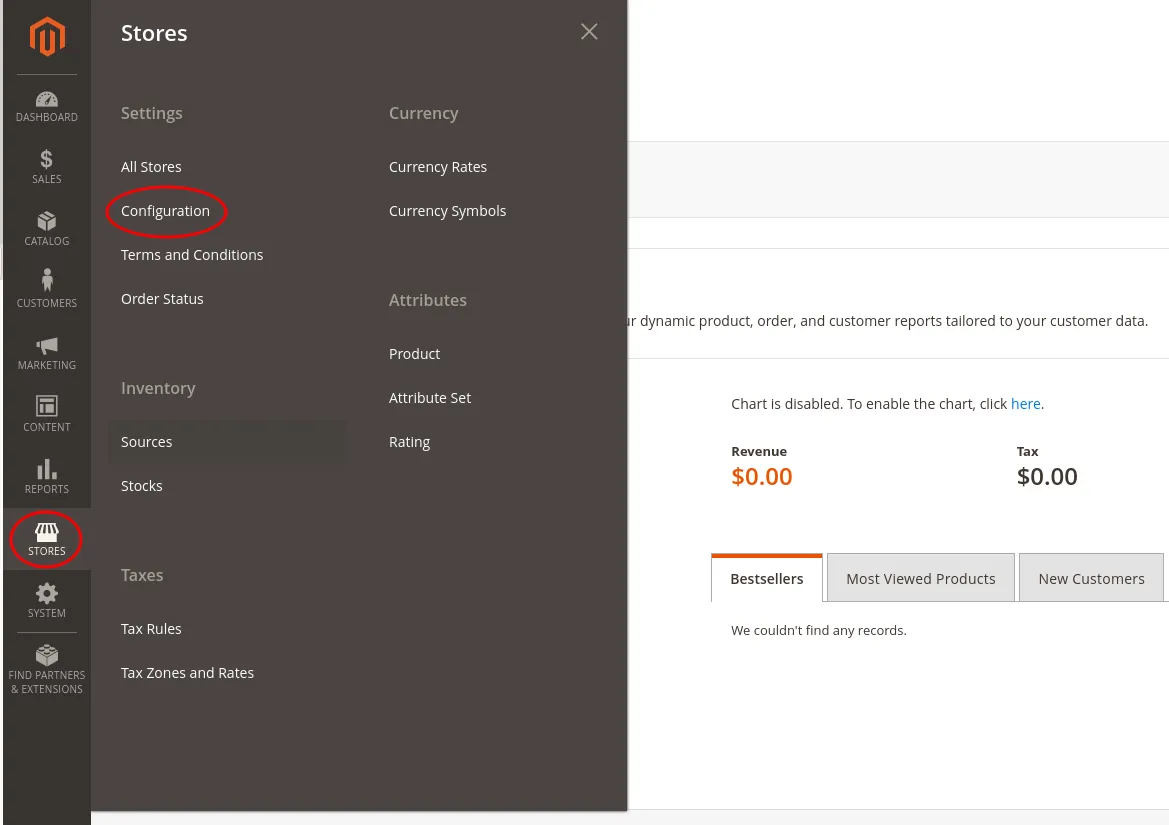
If the section is missing, flush the cache again. You may need to restart the web server (or the Magento container) before Releva shows up under Stores › Configuration.
Configure
Section titled “Configure”In Releva: copy the Secret Key
Section titled “In Releva: copy the Secret Key”- Open Settings › Shop & Integration. On the General tab, Platform shows Magento 2.x. If your account has several shops, pick the shop for this store view in the shop switcher first.
- Scroll to Secret Key and select the copy icon next to it. The module asks only for this key; the Access Token is not typed into Magento.
The screenshots of these two steps are in Verify. For the two keys and what each is for, read Find your Access Token and Secret Key.
In Magento: activate the store view
Section titled “In Magento: activate the store view”-
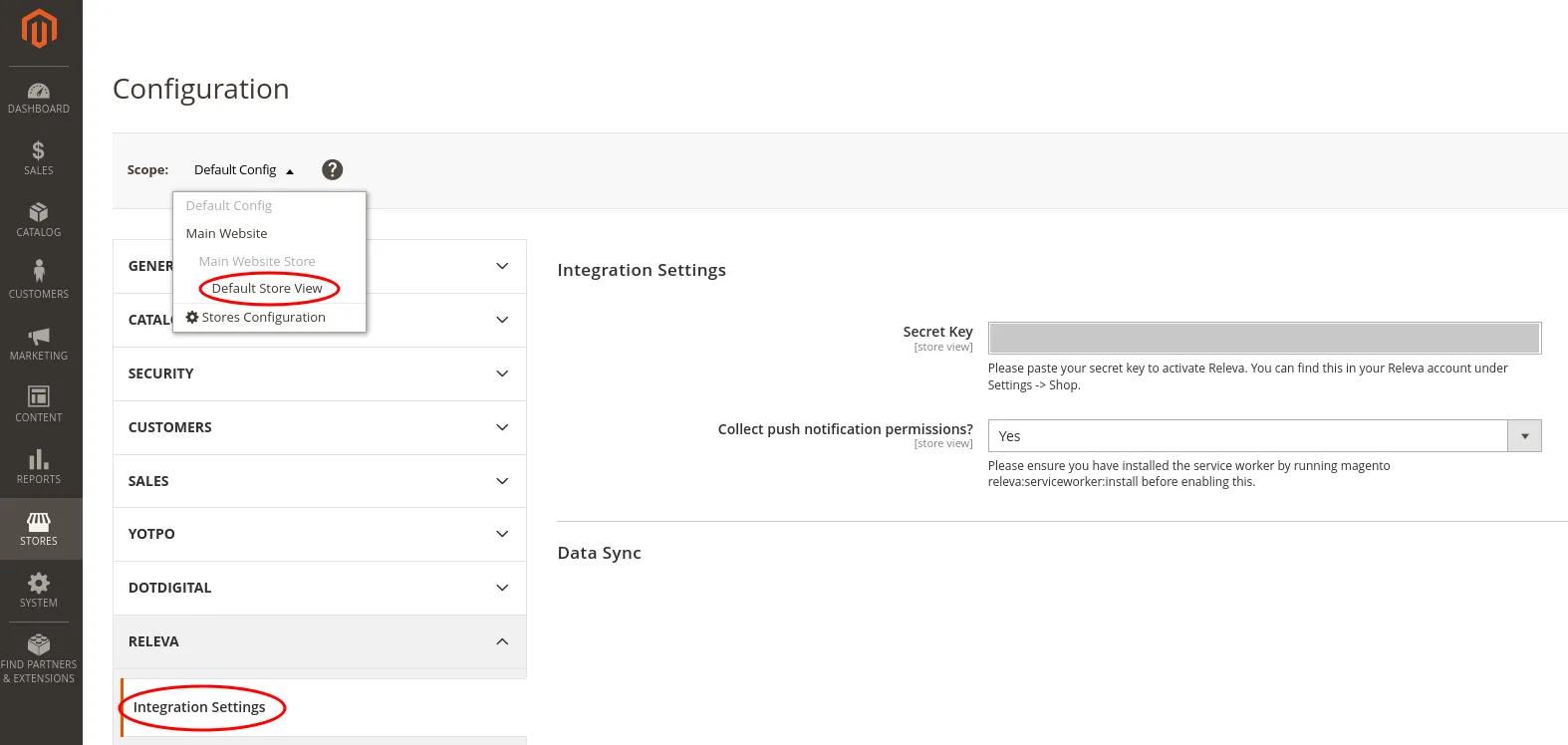
In Stores › Configuration › Releva › Integration Settings, open the Scope switcher at the top left and select the store view you are connecting, for example Default Store View. Do not stay on Default Config when you have several store views.
-
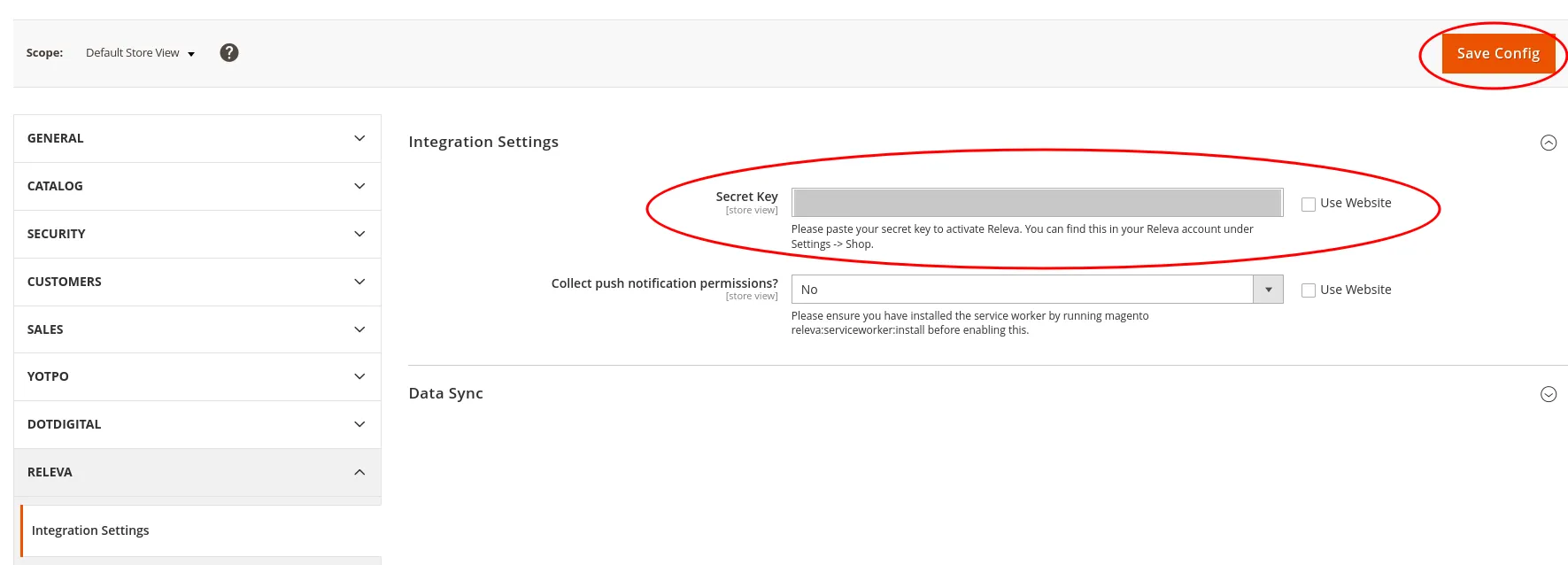
Clear Use Website next to Secret Key and paste the key you copied from Releva. The field’s help text still says “Settings -> Shop”; the current path in Releva is Settings › Shop & Integration › General.
-
Select Save Config. From now on the module inserts the Releva tracking snippet and the personalization blocks on the storefront pages. Flush the Magento cache if nothing changes.
-
Repeat for every other store view, each with the Secret Key of its own Releva shop.
Optional: collect web push permissions
Section titled “Optional: collect web push permissions”Skip this if you do not send web push notifications from Releva.
-
From the Magento root, run
bin/magento releva:serviceworker:installand flush the cache. Then openhttps://your-shop.example.com/releva-service-worker.min.jsin a browser; the file must load. -
In Integration Settings, set Collect push notification permissions? to Yes and select Save Config. Flush the cache.
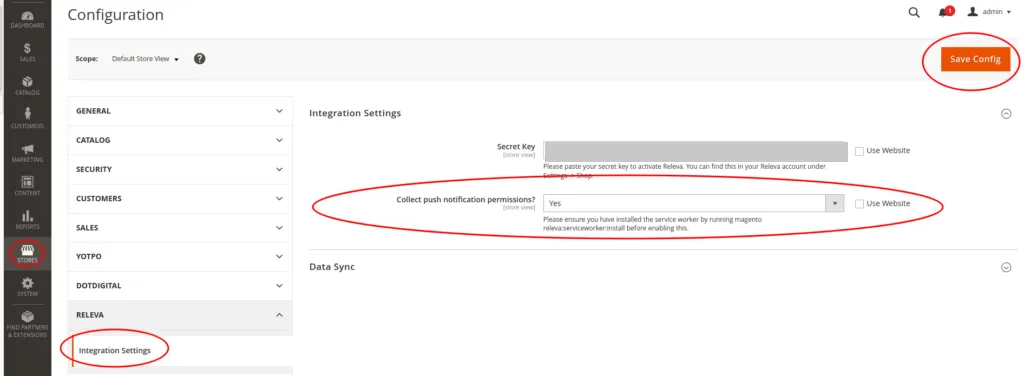
If the install command fails, run it as a user who may write to the Magento root, or copy releva-service-worker.min.js from the module into the web root yourself. Once visitors accept the browser prompt, the Releva SDK registers the worker and posts the subscription to Releva. Sending is covered in How push notifications work.
Required under GDPR and similar laws: the consent cookie
Section titled “Required under GDPR and similar laws: the consent cookie”Under Privacy and Data Protection, enter the name of the cookie your consent banner sets when a visitor agrees to analytics and first-level marketing, in Consent cookie name. If the cookie must also hold a specific value, enter it in Consent cookie value; leave the value empty to check only that the cookie exists. Example: a banner that sets cookielaw=1 needs name cookielaw and value 1.
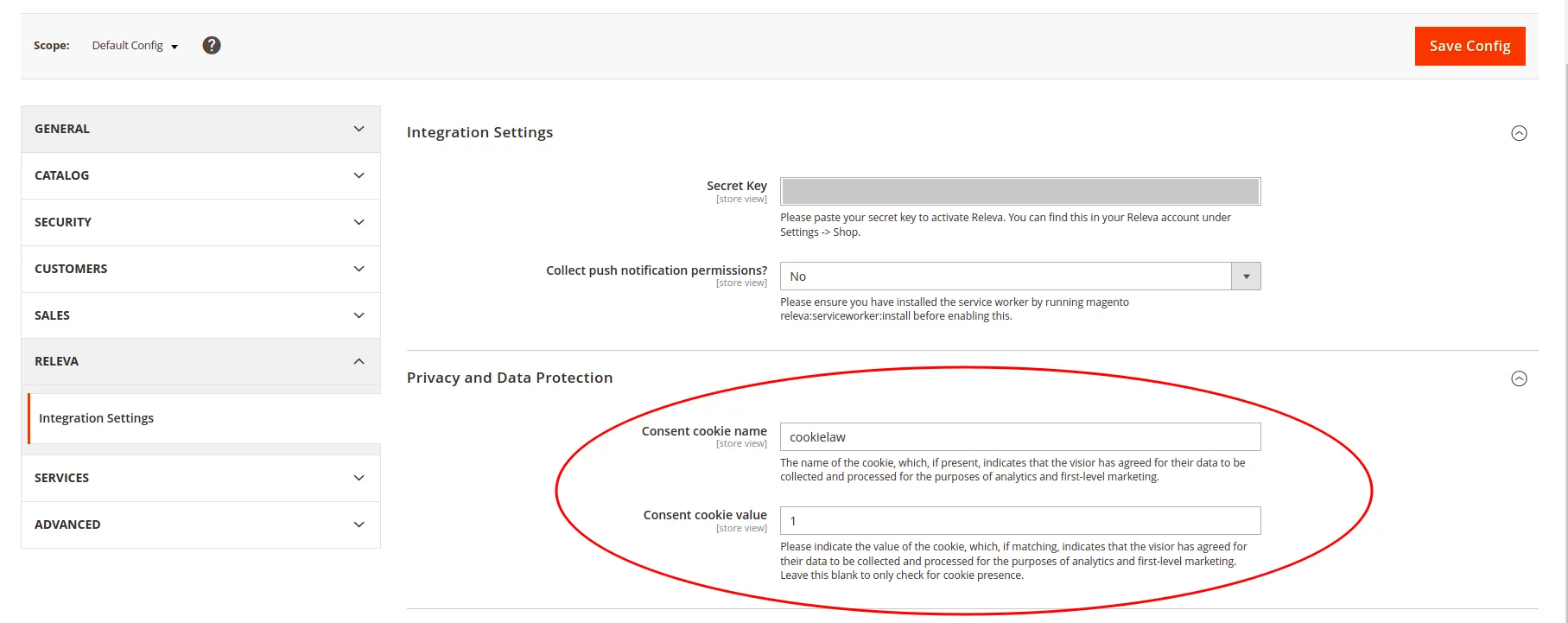
You are responsible for configuring this correctly where data protection law applies to you.
In Releva: check the sync settings
Section titled “In Releva: check the sync settings”When the shop was created with platform Magento 2.x, Releva filled in three addresses from the shop URL:
| Setting | Where in Releva | Default |
|---|---|---|
| Catalog sync URL (Catalog Sync Type API) | Settings › Shop & Integration › Catalog Sync | https://your-shop.example.com/releva/integration/products |
| Subscriber Sync API | Settings › Messaging › General, visible when Subscription Management is External | https://your-shop.example.com/releva/integration/subscribers |
| Email Unsubscribe URL | Same place | https://your-shop.example.com/newsletter/manage/ (Magento’s own newsletter page) |
Two things are not set for you:
- Catalog Sync Schedule is empty. Releva presets a nightly schedule for Shopify shops only. Without a cron expression Releva never pulls your full catalog on its own; Sync Now starts one by hand. To add a schedule, follow Schedule a full catalog sync.
- Subscription Management defaults to Internal on Create Shop. In that mode the two subscriber fields are hidden. If Magento stays the record of who is subscribed to your newsletter, switch to External and save: Choose how Releva manages subscriptions.
If your store view’s base URL differs from the shop URL in Releva (store code in the path, a subfolder, index.php), edit the addresses accordingly.
Verify
Section titled “Verify”Check that Releva sees your Magento shop
Section titled “Check that Releva sees your Magento shop”Recorded in the Releva admin on a demo shop set to Magento 2.x, as a regular shop user. Nothing is typed or saved. The shop name, URL and keys are masked, and the catalog address uses an example host.
-
Open Settings › Shop & Integration. On the General tab, Platform shows Magento 2.x or Magento 1.x.
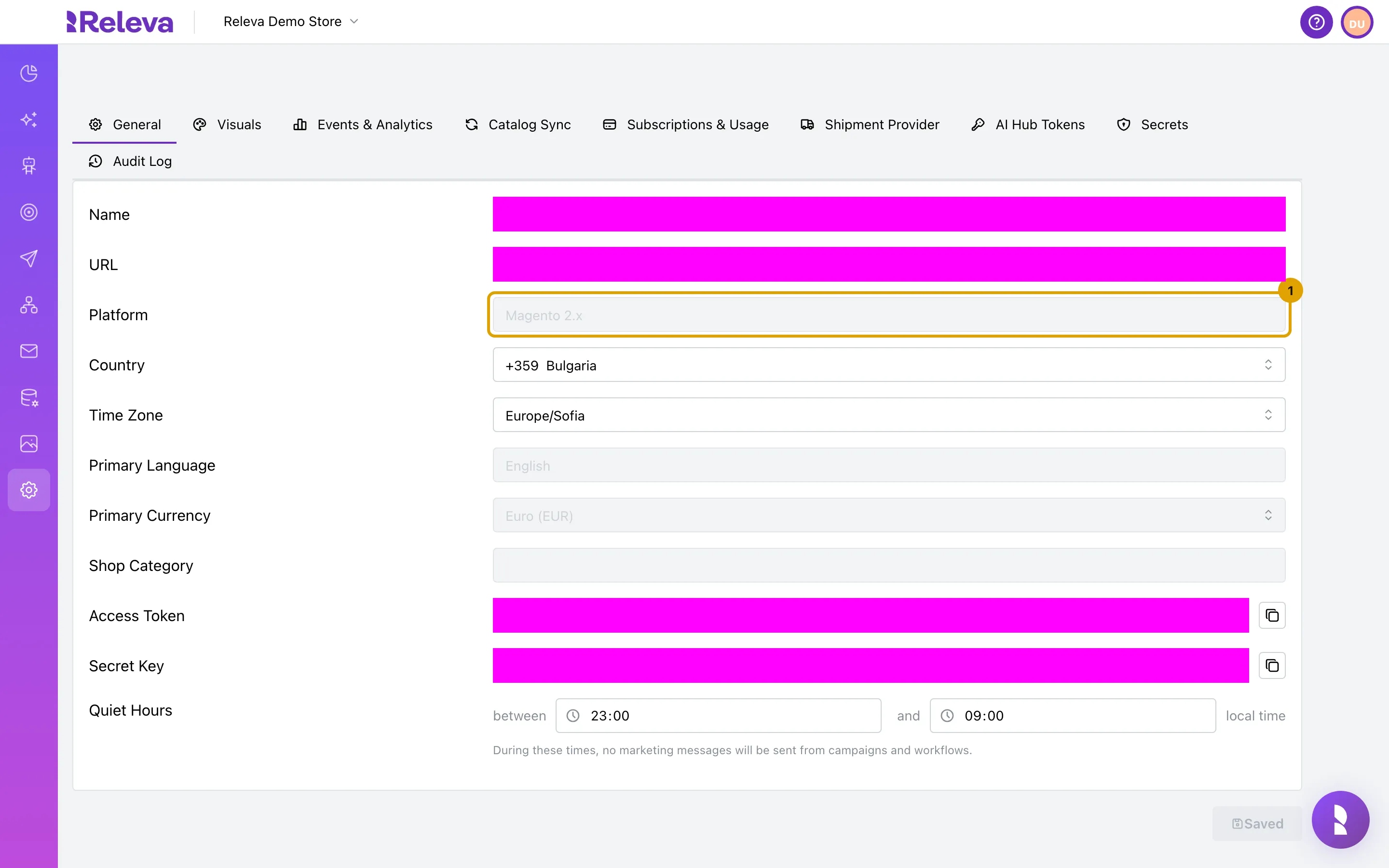
-
Secret Key is the key the Releva extension asks for in your Magento admin. Select the copy icon next to it to copy it.
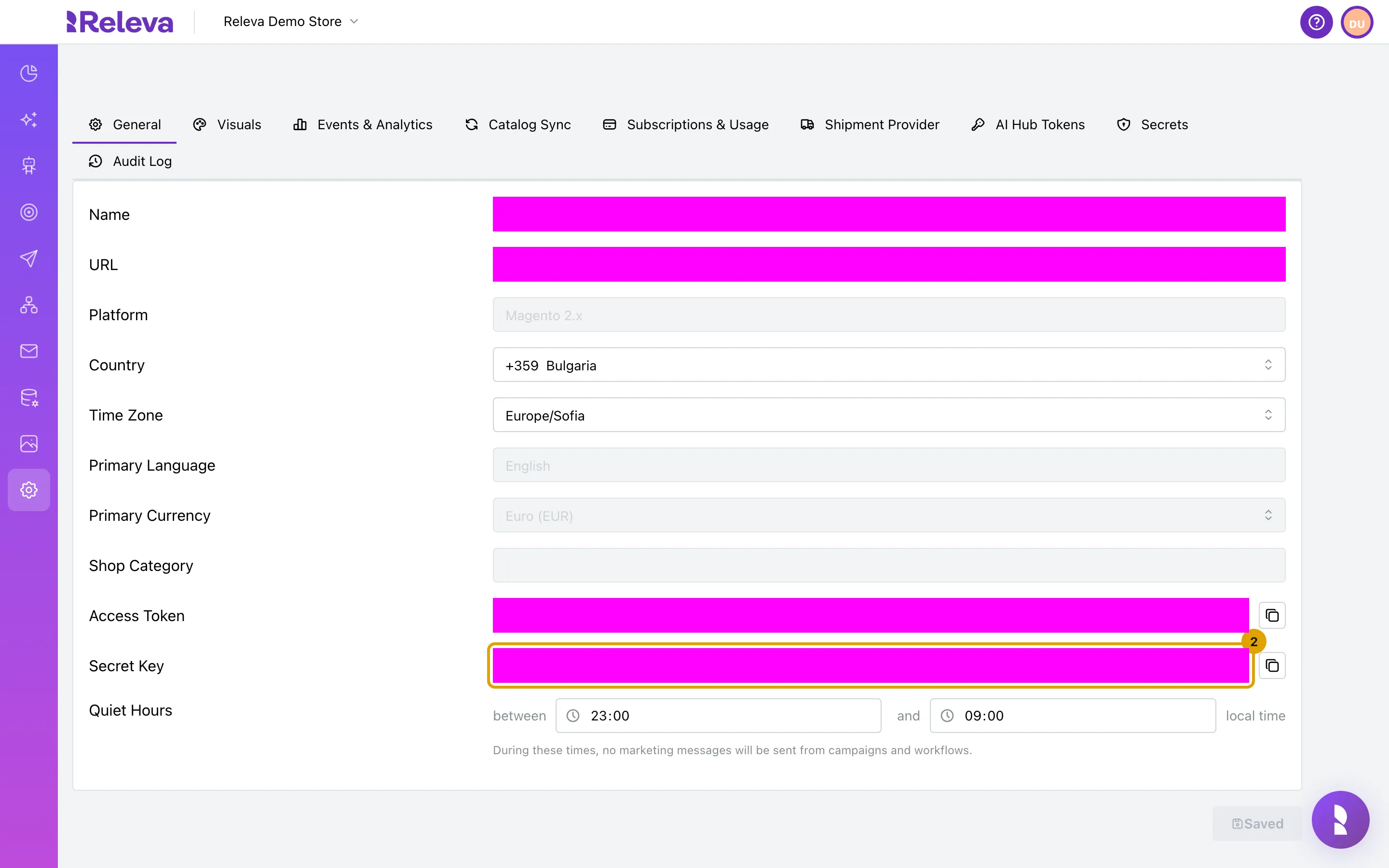
-
Select the Catalog Sync tab.
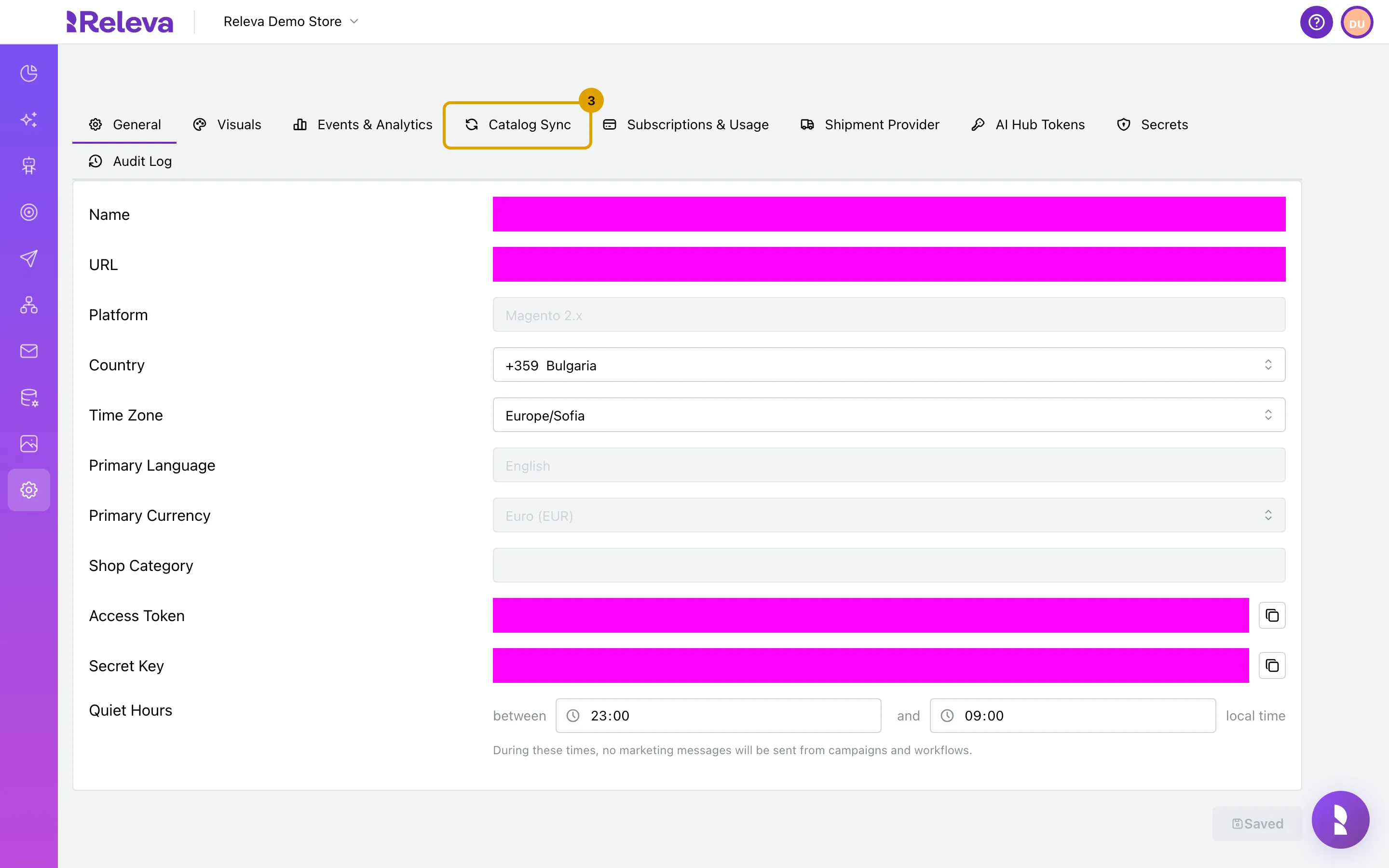
-
With API selected, the address ends in
/releva/integration/products. This is the catalog endpoint of the extension, filled in when your shop was created in Releva.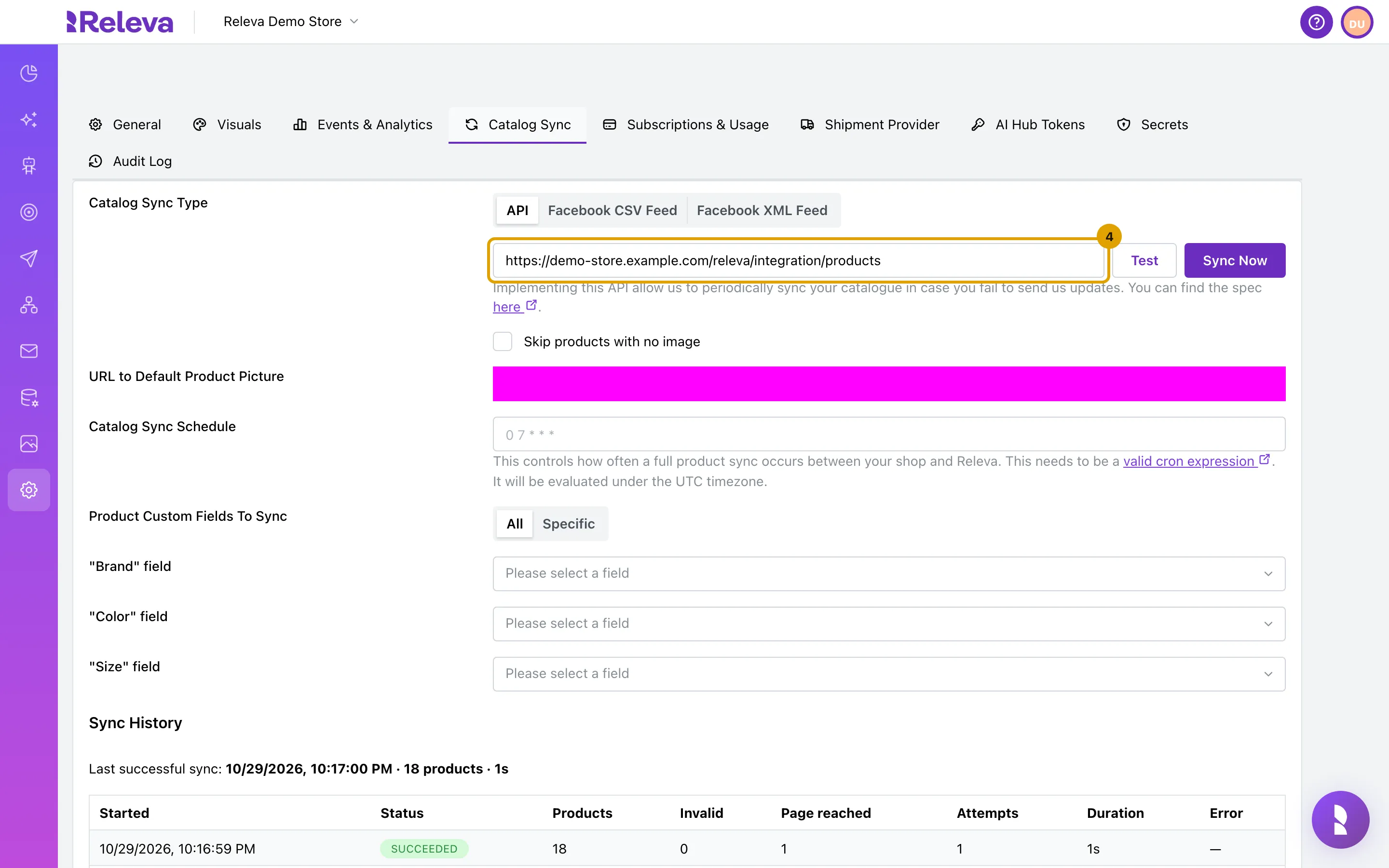
-
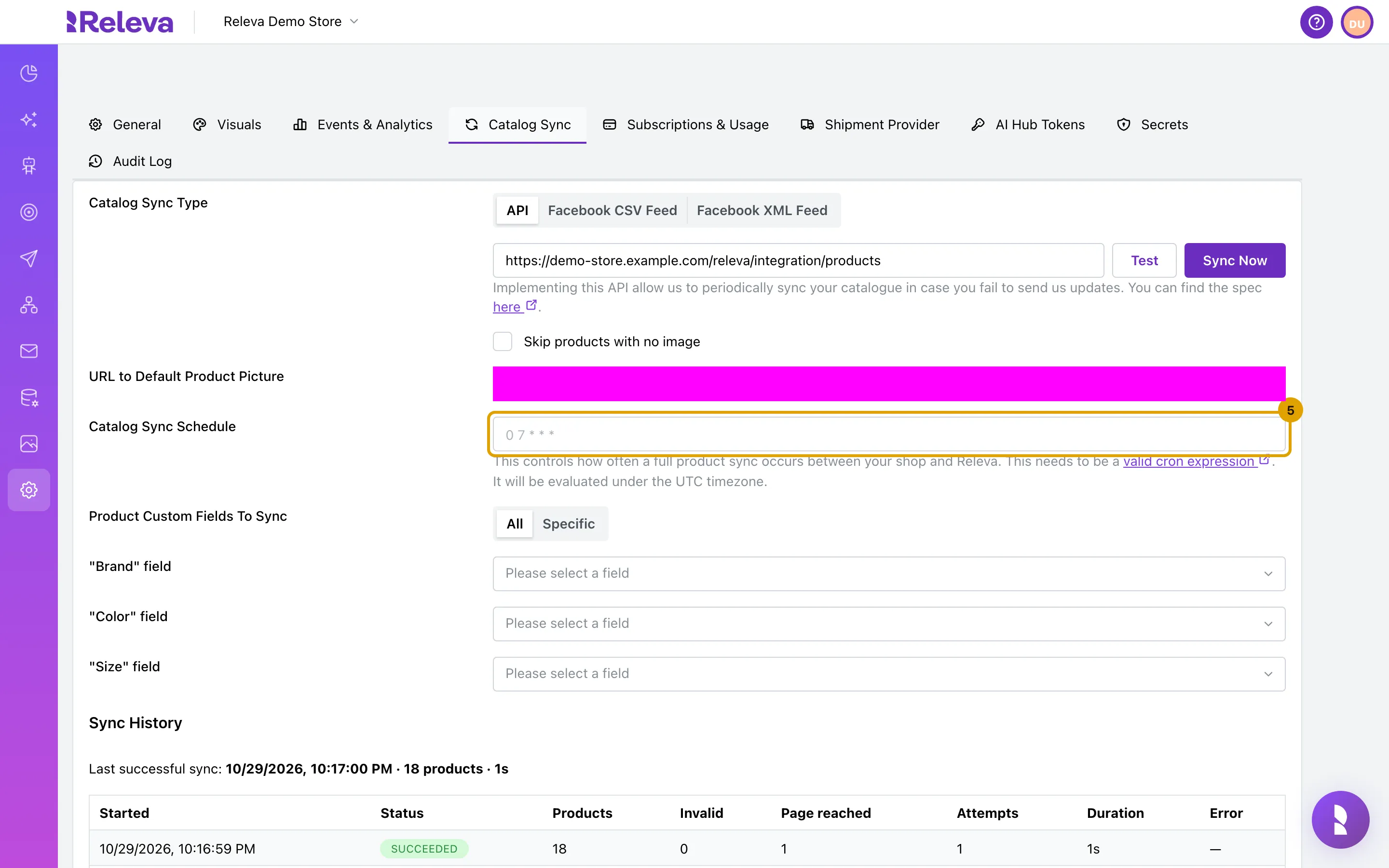
Catalog Sync Schedule stays empty until you enter a cron expression. Without one, Releva runs no scheduled full sync; Sync Now starts one by hand.
-
Sync History lists each catalog sync with its status and product count. Last successful sync shows when Releva last read your catalog; Never means it has not read it yet.
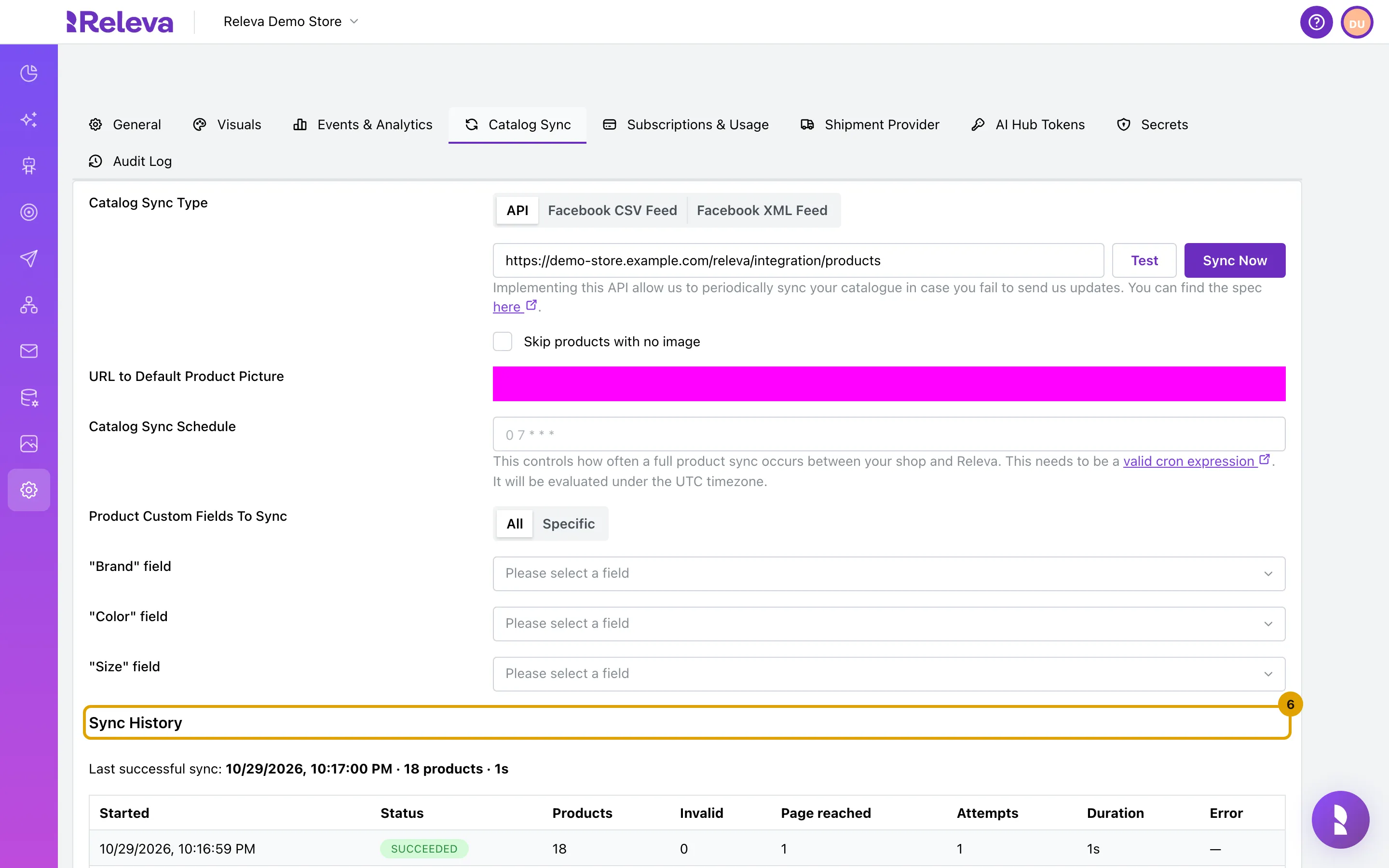
Select Test next to the address to make Releva request page 1 of your catalog endpoint with your secret key; the response, or the error, appears under the field. Select Sync Now to start a full sync; it appears in Sync History once it has run.
Check that your shop’s data reaches Releva
Section titled “Check that your shop’s data reaches Releva”Open your storefront in a browser, view a page or two and a product, then check Data Platform › Events, Data Platform › Products and Data Platform › Profiles. The screens are the same for every integration: Check that your store data arrives.
Other event types to look for once the module runs: Viewed Product, Cart Item Added, Cart Checkout Completed and Registered. Without Include Anonymous Profiles, the profiles list contains only profiles with an email address or phone number.
Troubleshooting
Section titled “Troubleshooting”The Releva section is missing under Stores › Configuration. Run bin/magento setup:upgrade and bin/magento cache:flush again; you may also need to restart the web server process. Make sure the module sits in app/code/Releva/Releva, not one level deeper.
Nothing appears in Data Platform › Events. Check that you saved the key in the store view scope you are browsing, not only in Default Config, and that you flushed the cache. Open the storefront page source and look for releva-sdk-js. If your consent cookie is configured, accept the banner first. Use the tracking-snippet check to confirm the shop’s Access Token works.
Test next to the catalog URL fails. Releva calls GET {url}?page=1 with authorization and x-rlv-authorization: Bearer <secretKey> and expects JSON with products and pageCount or nextCursor. A 404 means the module is not active for that store view or the URL does not match your base URL (store code, subfolder). An authentication error means the key in Magento differs from the one in Releva; both must be the Secret Key of the same shop. The contract is in the catalog pull-sync reference.
Products disappear from Releva after a full sync. About 120 seconds after a complete pass, Releva deletes every product the endpoint did not return. Products disabled or out of stock should still be returned with available: false. See Full syncs delete what they do not see.
Sync History stays at Last successful sync: Never. No schedule is preset for Magento shops. Enter a cron expression under Catalog Sync Schedule or select Sync Now.
Add-to-cart answers 400 from the Releva API. POST /api/v0/carts/update rejects unknown top-level keys and the paid-order fields cartPaid and orderId. Prices sent as PHP decimal strings such as "12.5000" are accepted.
The same customer triggers “Registered” conversions on every page. This no longer happens. The module renders registeredAt in window.relevaProfile on every page for a logged-in customer; Releva fires Registered and the ad-platform registration events only when it first records the registration. Nothing to configure.
Help links in the Releva admin open old documentation URLs. The Catalog Sync tab links to /documentation/sync-apis/periodical-product-sync/; its content is now in the catalog pull-sync reference.
What syncs
Section titled “What syncs”What a module sends can change between module versions. If you depend on one of these calls, ask your account manager whether your module version makes it.
| Data | Direction and endpoint | When |
|---|---|---|
| Page views, product views, searches, the logged-in customer | Browser. The module renders the Releva SDK snippet; the SDK posts the page context to POST /api/v0/push/{accessToken}. The customer is in window.relevaProfile, with registeredAt on every page |
Every storefront page |
| Registration | Same push. Releva records Registered once, on the push that first records the registration | First page after sign-up |
| Cart changes | Server. The module’s add-to-cart observers send the full current cart to POST /api/v0/carts/update with the secret key, identified by the SDK cookies rlv_u / rlv_p or by email/phone. Releva derives Cart Created, Cart Item Added, Cart Item Removed and Cart Updated events |
On add-to-cart and cart changes |
| Catalog, full | Releva pulls GET https://your-shop/releva/integration/products?page=&cursor= with authorization and x-rlv-authorization: Bearer <secretKey>; the module serves this route |
Catalog Sync Schedule, Sync Now, or POST /api/v0/products/sync |
| Product deletes | DELETE /api/v0/products/{id} by plain product id |
On product delete |
| Catalog, incremental | POST /api/v0/products, POST /api/v0/products/availability |
On product save or stock change |
| Subscribers, full | Releva pulls GET https://your-shop/releva/integration/subscribers?page=&cursor= (same headers); each item is upserted as a profile with its subscribedAt |
Sync Now next to Subscriber Sync API, or POST /api/v0/subscribers/sync |
| Orders | POST /api/v0/carts with cartPaid and orderId |
On order placement |
| Order status | POST /api/v0/events with action: orderStatusChanged; a storefront statusLabel may accompany an internal status code |
On order status change |
| Newsletter consent | POST /api/v0/subscribe / POST /api/v0/unsubscribe; the Email Unsubscribe URL default points at Magento’s newsletter/manage/ page |
On newsletter changes |
| Web push subscriptions | The SDK registers releva-service-worker.min.js and posts the subscription to POST /api/v0/pushSubscriptions/{accessToken} |
When Collect push notification permissions? is Yes and the visitor accepts |
| Tracking consent | The module checks the configured consent cookie before tracking | Every page |
| Product blocks and banners | Rendered by the SDK from the push response; the module places them on “all relevant pages” | Every page |
| Refunds | POST /api/v0/refunds |